Project Overview
Modern SOC teams face an overwhelming volume of daily security alerts, making manual triage slow, inconsistent, and prone to analyst fatigue. This project addresses that challenge by building a fully autonomous SOC triage pipeline that detects security events, enriches them with live threat intelligence, and uses Claude Sonnet 4.6 as an AI Senior SOC Analyst to produce structured, MITRE ATT&CK-mapped incident reports — all without human intervention.
The pipeline ingests Windows Security and Sysmon event logs from a Windows 10 VM into a Splunk Enterprise server running on Ubuntu. Four custom SPL detection rules fire webhook alerts into n8n, which acts as the SOAR layer — routing each alert type through the appropriate enrichment path (AbuseIPDB for IP reputation, VirusTotal for file hash analysis) before forwarding the enriched context to Claude. The final triage report is delivered to a dedicated Slack channel, formatted as a structured incident ticket with verdict, MITRE ATT&CK mappings, and remediation steps.
Pipeline Architecture
Detection Rules (Splunk SPL)
Four custom SPL detection rules cover the most common Windows attack patterns. Each rule appends an alert_type field used by n8n to route the alert through the correct enrichment and triage path.
Triggers when more than 5 failed login attempts occur within a 5-minute window on the Windows VM, indicating a potential brute force or password spray attack.
index="moazzz-project" EventCode=4625
| bin _time span=5m
| stats count by _time, host, Account_Name, Source_Network_Address
| rename host AS workstation, Account_Name AS user,
         Source_Network_Address AS attacker_ip
| where count > 5
| eval alert_type="brute_force"
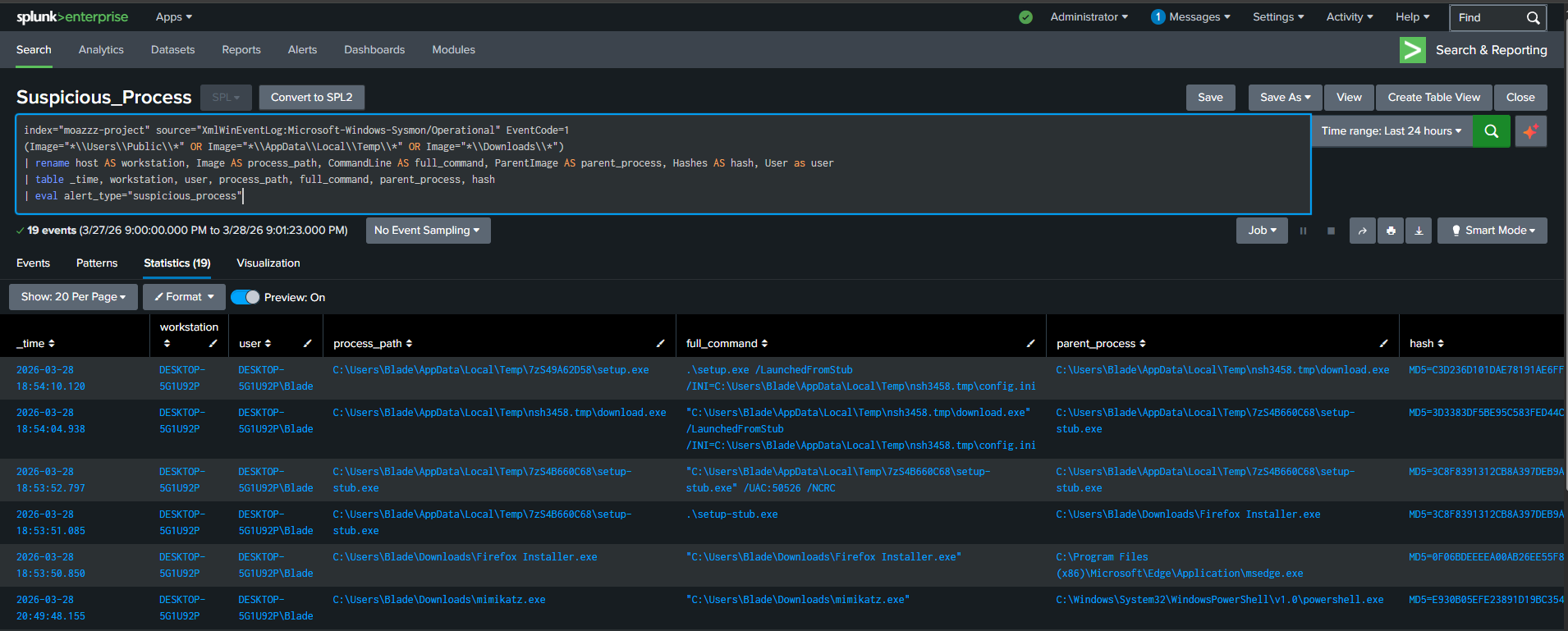
Detects process execution from high-risk directories (Temp, Downloads, Public) — common staging locations for malware droppers and LOLBins.
index="moazzz-project"
  source="XmlWinEventLog:Microsoft-Windows-Sysmon/Operational"
  EventCode=1
  (Image="*\\Users\\Public\\*"
    OR Image="*\\AppData\\Local\\Temp\\*"
    OR Image="*\\Downloads\\*")
| rename host AS workstation, Image AS process_path,
         CommandLine AS full_command, ParentImage AS parent_process,
         Hashes AS hash, User AS user
| table _time, workstation, user, process_path,
        full_command, parent_process, hash
| eval alert_type="suspicious_process"
Flags new scheduled task creation — a common persistence mechanism used by attackers to maintain access across reboots (MITRE ATT&CK T1053.005).
index="moazzz-project" EventCode=4698
| xmlkv Message
| rename host AS workstation, Account_Name AS user,
         Task_Name AS task_name, Command AS run_command,
         Arguments AS run_args
| table _time, workstation, user, task_name, run_command, run_args
| eval alert_type="scheduled_task"
Detects audit log and system log clearing — a strong indicator of post-compromise cleanup activity used to destroy forensic evidence (MITRE ATT&CK T1070.001).
index="moazzz-project"
  (EventCode=1102 OR EventCode=104)
| rename host AS workstation, Account_Name AS user
| table _time, workstation, user, Message
| eval alert_type="log_clearing"
n8n SOAR Workflow
n8n acts as the orchestration layer between Splunk and Claude. A Switch node reads the alert_type field from the Splunk webhook payload and routes execution through the appropriate enrichment path before reaching the AI triage stage.
{{ $json.body.result.hash.split(',').find(h => h.startsWith('SHA256=')).split('=')[1] }}
Pipeline Test — Mimikatz.exe
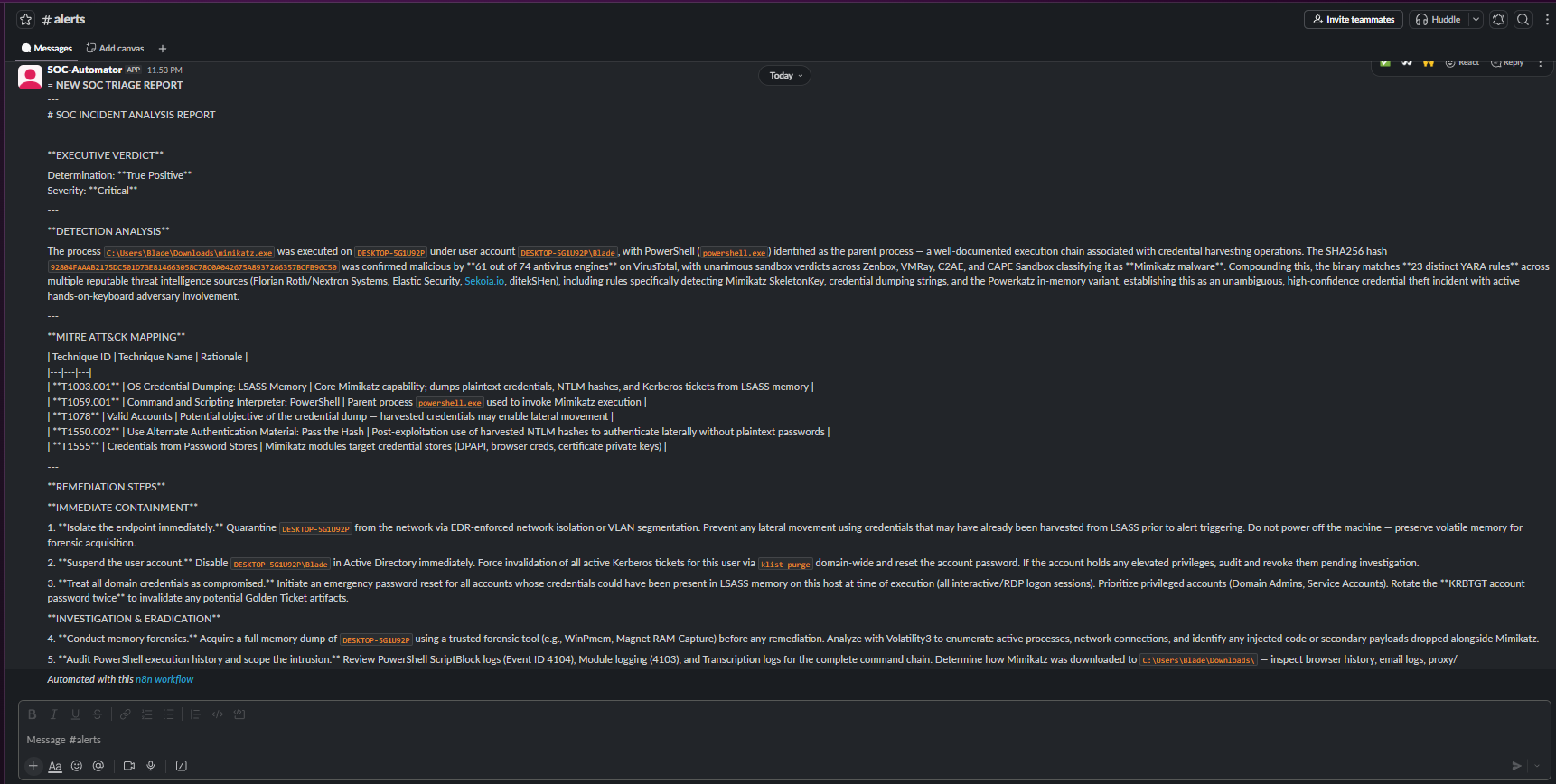
A live test was conducted by executing mimikatz.exe from the Downloads folder on the Windows 10 VM, triggering the Suspicious Process Execution detection rule. Below are the Splunk alert and the resulting Claude triage report delivered to Slack.